Imagine you’ve just been told you have arthritis or a tendon injury. You start researching, and two names keep coming up: PRP and stem cell therapy. A friend swears one fixed their knee. Social media calls the other a miracle cure. Here is the honest answer: the right choice depends on your diagnosis, not on which treatment sounds more impressive.
It helps to know up front that both PRP and stem cell therapy belong to a family of treatments called Orthobiologics. That simply means we take cells from your own body, concentrate them, and place them precisely where they’re needed, often with the help of some form of image guidance so we can see exactly where the medicine goes. At OrthoNY, both treatments are performed by orthopedic specialists using this same approach. What differs between the two is where those materials come from and how much regenerative power they carry.
What Is PRP Therapy?
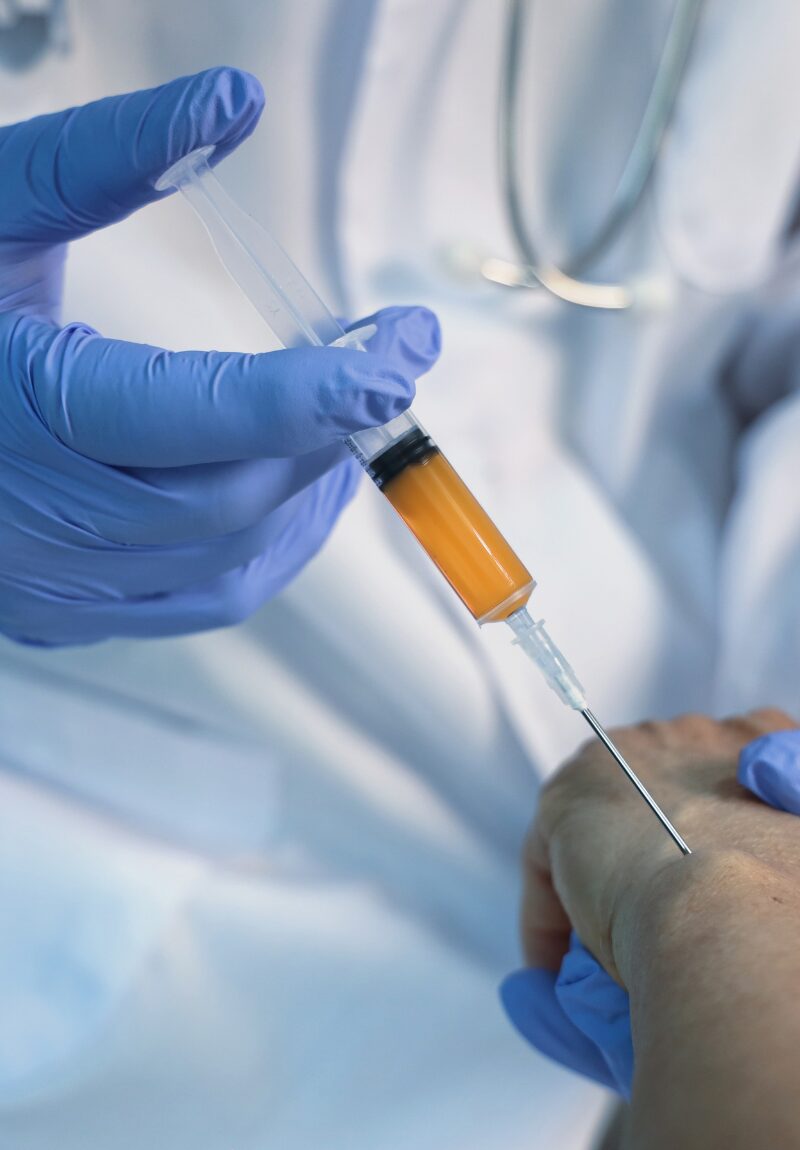
PRP stands for platelet-rich plasma. It starts with something simple: a small blood draw from your arm, just like a routine lab test. We place that blood in a centrifuge, a machine that spins it quickly, which separates out and concentrates the platelets. These are the tiny cells that jump into action whenever your body is injured.
Think of platelets as your body’s first-responder crew. Every time you get a cut or a bruise, platelets rush to the scene carrying growth factors (signals) that tell the surrounding tissue to repair itself. PRP is like calling in a much larger crew of those responders and delivering them, under image guidance, straight to the injured area. Instead of a handful of workers showing up, you send a whole team to the site that needs repair.
Because PRP comes entirely from your own body, involves only a blood draw, and takes under an hour, it’s the most straightforward orthobiologic option, and often the first one we consider.
What Are Stem Cells? (Bone Marrow Concentrate Explained)
When most people say “stem cell therapy” in an orthopedic setting, what they’re often describing is bone marrow concentrate, or BMAC. There are other forms of stem cells, but let’s keep the conversation to the most common form. Rather than coming from a blood draw, BMAC is concentrated from your own bone marrow, typically drawn from the back of the pelvis, and then spun down to concentrate its healing components before it’s injected under ultrasound guidance.
If PRP is a specialized first-responder crew, bone marrow concentrate is more like sending in an entire construction and repair company. Bone marrow doesn’t just contain growth factors, it also carries a richer mix of regenerative cells and signaling molecules. The key idea to understand is this: because it’s concentrated from your own bone marrow, BMAC provides a broader regenerative environment than PRP alone. It brings more of the raw materials your body draws on to rebuild and repair tissue.
That broader toolkit is exactly why BMAC becomes valuable in more advanced or complex situations, which we’ll get to shortly.
PRP vs. Bone Marrow Concentrate: A Side-by-Side Look
Here’s how the two options compare across the things patients ask about most:
| PRP (Platelet-Rich Plasma) | Bone Marrow Concentrate (BMAC) | |
|---|---|---|
| Source | A small blood draw from your arm, spun down to concentrate your own platelets. | A sample of your own bone marrow, usually taken from the back of the pelvis, then concentrated. |
| The Procedure | Quick in-office draw, spin, and a single image-guided injection. Typically under an hour. | In-office aspiration of bone marrow followed by concentration and ultrasound-guided injection. Somewhat longer. |
| Recovery | Minimal downtime. Some soreness for a few days; most resume normal activity quickly. | Short recovery with mild soreness at the pelvis and treatment site for several days. |
| Invasiveness | Least invasive. Simple blood draw, no bone involvement. | Slightly more involved because bone marrow is aspirated, but still a same-day outpatient procedure. |
| Cost | Lower. | Typically higher, reflecting the added step of harvesting and concentrating bone marrow. |
| Typical Uses | Tendon injuries, mild-to-moderate arthritis, and early degenerative conditions. | More advanced arthritis, larger tendon tears, and cases seeking a broader regenerative approach. |
Depending on degree and severity of degenerative change, surgical options may be required.
Which Conditions Respond Well to PRP?
PRP tends to shine with tendon injuries and earlier-stage joint problems, situations where the tissue is irritated or partially damaged but still has plenty of healing potential to build on. Conditions that often respond well include:
- Tennis elbow (lateral epicondylitis)
- Golfer’s elbow (medial epicondylitis)
- Rotator cuff tendon irritation and partial tears
- Mild-to-moderate knee, hip, or shoulder arthritis
- Other nagging tendon problems that haven’t settled with rest and therapy
For many patients, PRP delivers meaningful relief with minimal downtime, which makes it a natural starting point for the right diagnosis.
When is Bone Marrow Concentrate Used?
Bone marrow concentrate comes into play when a condition is more advanced, more structural, or hasn’t responded to simpler measures. It’s often the better fit for:
- More advanced knee arthritis or hip arthritis
- Larger tendon tears
- Conditions that have failed conservative treatment such as therapy, medication, or prior injections
- Patients looking for a more comprehensive orthobiologic approach
In these cases, the broader regenerative environment that BMAC provides can make a real difference where PRP alone might not be enough.
Can PRP and Bone Marrow Concentrate Be Combined?
Yes. The two are most often used together, and there’s a logic to why they complement each other. Bone marrow concentrate supplies the richer mix of regenerative cells and signaling molecules, while PRP contributes a concentrated dose of growth factors that help support and “feed” that environment. In other words, PRP can act as fuel for the cellular materials delivered by BMAC, helping create conditions where repair can take hold.
So, Which One Do I Recommend?
Rather than telling every patient that one treatment is simply superior, I make a recommendation based on your particular situation. Several factors shape that decision:
- Your diagnosis and what’s actually driving your pain
- Your MRI findings and the degree of arthritis or tissue damage
- Your activity level and the demands you place on the joint or tendon
- Your age and overall health
- Previous treatments you’ve tried and how you responded
- Your personal goals, whether that’s returning to sport, staying active, or delaying surgery
A younger patient with an isolated tendon injury may do beautifully with PRP, while someone with more advanced arthritis who has already tried conservative care may be a better candidate for bone marrow concentrate or a combination. The point is that the right treatment is the one matched to your diagnosis and your goals, not a one-size-fits-all recommendation. That personalized approach is exactly what good orthobiologic care should look like.
Find Out If You’re a Candidate.
Frequently Asked Questions
Which is better, PRP or stem cell therapy?
Neither is universally better. PRP works well for mild-to-moderate arthritis and tendon injuries, while bone marrow concentrate offers a broader regenerative approach for more advanced cases. The right choice depends on your diagnosis, MRI findings, and how you’ve responded to prior treatment.
Can PRP and stem cell therapy be combined?
Yes. The two are often combined, since bone marrow concentrate supplies a richer mix of regenerative cells while PRP delivers concentrated growth factors that help support that environment. Combining them can create better conditions for healing than either treatment alone.
How are PRP and stem cell therapy injections administered?
Both are delivered with image guidance to ensure precision. PRP injections are typically guided directly to the injured area, while bone marrow concentrate is injected under ultrasound guidance after being drawn from the pelvis and concentrated.
Is PRP or stem cell therapy more expensive?
Bone marrow concentrate typically costs more than PRP, reflecting the added step of harvesting and concentrating bone marrow rather than a simple blood draw. Cost is one of several factors worth discussing with your provider as part of your treatment plan.
Is PRP or stem cell therapy considered surgery?
No. Both are minimally invasive, same-day outpatient procedures rather than surgery. PRP involves only a blood draw, while bone marrow concentrate requires a brief bone marrow aspiration. Depending on the severity of a condition, surgical options may still be discussed separately.